
How To Choose New Flooring Like A Pro!
Carpet | Pad | Installation | LVP | Forms | Best Dealers
Carpet Fibers
Nylon - PET - Polyester - Olefin - PTT/Triexta
 Choosing
the Right Carpet Fiber? The type of Carpet Fiber you select will
determine how long it lasts, how soft it feels, what colors are available, how
easily it cleans and how much it costs. This is one of the most critical
factors homeowners face when choosing and comparing new carpet.
Choosing
the Right Carpet Fiber? The type of Carpet Fiber you select will
determine how long it lasts, how soft it feels, what colors are available, how
easily it cleans and how much it costs. This is one of the most critical
factors homeowners face when choosing and comparing new carpet.
There are several carpet fibers available today and they all have their benefits and pitfalls. Here are the main carpet fibers available today:
-
Nylon - Two main versions are Stainmaster 6.6 and Anso 6.0 and available in various "soft" styles.
-
Sorona - also known as Triexta, Smartstrand and PTT.
-
Smartstrand or Stainmaster? Which is the best choice for you?
-
P.E.T. Polyester - This is a soft and stain resistant fiber made from recycled soda bottles.
-
Polyester - A soft and yet inexpensive fiber to manufacture which makes it popular for homeowners who are on a budget.
-
Olefin - Also known as polypropylene. A durable fiber that is inexpensive to manufacture but hard to clean.
-
Wool - A soft and natural fiber derived from sheep, is fire-resistant but very expensive to buy and more costly to install and maintain.
You must compare apples to apples. For example, you cannot compare a NYLON carpet to a POLYESTER carpet, or a WOOL carpet to an OLEFIN carpet. This would be like comparing apples to oranges. You have to compare similar carpets and narrow it down to the one that best meets your needs and lifestyle as well as your budget.
No matter what, don't listen to any salesperson that says polyester carpet is just as durable as nylon carpet. Nylon is the most durable fiber and most resilient carpet fiber available today. So if you want your new carpet tolerate heavy foot traffic and continue to look like new for years to come, then nylon is the fiber you need to select. Learn more about Carpet Styles
Carpets Made of 100% Nylon
Nylon is a generic name or designation for a family of synthetic polymers first produced in 1935 by the Dupont Company. As far as fibers go, Nylon is the most durable and the most resilient of all carpet fibers.
A resilient fiber is defined as having the ability to return to its original form or position after being bent, compressed, or stretched. Nylon is the most resilient fiber used to make carpet. This is what keeps a nylon carpet looking like-new longer than any other fiber. Nylon is one of the more expensive fibers second only to wool.
I would suggest you consider choosing a Nylon carpet if you have a lot of foot traffic and longevity is your biggest concern.
"Do
"softer" nylons
hold up as well as the "regular" nylon fibers do?"
This is an excellent question. From my experience, I have found that the
"soft" nylon fibers are not quite as resilient as a standard denier
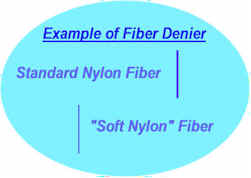
nylon fiber. The higher the denier, the heavier (or thicker) the strand or filament.
The way they make a standard nylon fiber softer is to make the strand thinner. By doing so, I firmly believe that some of the resiliency is lost. This thinner strand creates a carpet that is softer to the touch but the carpet pile may be more susceptible to matting and crushing over time.
Don't take this the wrong way, I'm not steering you away from buying a "soft nylon", but if you want to have the absolute most durable and most resilient nylon for the money, I suggest you avoid the so-called soft nylons like Tactesse, Lisse' and Caress, to name a few.
What is Carpet Fiber Denier?
Note: Fiber denier is easiest understood if you have ever gone fishing and used a nylon filament fishing line. The thicker the line is, the stronger it is. When fishing for Trout most fishermen use a thin 6-pound test line.
For bigger
 fish
like Steelhead or Salmon, a thicker 10 or 12-pound nylon test line may be
selected. Some carpet fibers are manufactured thinner to make a carpet that
feels softer to the touch, but in doing so some of the strength, durability or
resiliency may be sacrificed.
fish
like Steelhead or Salmon, a thicker 10 or 12-pound nylon test line may be
selected. Some carpet fibers are manufactured thinner to make a carpet that
feels softer to the touch, but in doing so some of the strength, durability or
resiliency may be sacrificed.
Therefore I believe a carpet made with a standard Denier Nylon fiber will be more durable and more resilient than a carpet made with a thinner strand as used in today's branded "Soft Nylons"
Sorona® PTT (AKA Smartstrand® by Mohawk™)
If you want a carpet that is durable, soft and resist stains, Sorona® may be the fiber you are looking for. Sorona has permanent stain resistance that is engineered into the fiber and will never wear or wash off. But remember, no carpet is
completely stain proof.
Sorona® also known as Triexta or PTT was developed by DuPont™. It is a polymer derived from corn. It is said to have the best anti-stain properties and cleans easier than any other fiber. They also say it is very durable. Sorona™ is clearly more durable than PET or Polyester, but is it as durable as Nylon?
I do believe that Sorona may resists stains and clean a little bit easier than Nylon, but the durability and resiliency of Nylon is hard to beat. Either way, Sorona may be the fiber you need for your busy home or active lifestyle.
Sorona® is not a new fiber, it was invented back in the 1940's and was deemed too expensive to manufacture at that time to be able to compete with other carpet fibers like Nylon. Carpet prices have increased enough over the past 10 years to allow Sorona™ to be manufactured at a comparable cost.
Mohawk™ has a line of carpet styles using the Sorona fiber and they have branded it and call it Smartstrand®. DuPont™ and Sorona® are a trademark and a registered trademark of E.I. DuPont de Nemours and Company.
Sorona / Smartstrand UPDATE January 2022
My Latest Opinion Regarding Sorona® (Smartstrand™ by Mohawk)
Dear Alan,
Sorona has been around for many years now, do you think it is as good a fiber as they claim it is?
What I have come to believe at this point is that Sorona IS a durable fiber, it also cleans easily and resists stains better than Nylon. However, it is imperative that you choose the right quality or grade in order to be satisfied with the overall performance.
This is true with any carpet no matter what fiber it is
made of. This means having
enough face weight, high pile density and adequate tuft twist to meet or exceed your
needs, goals and lifestyle. It is also important to keep the pile height below
3/4 of an inch or risk potential matting and crushing.
Knowing what grade of carpet to buy is the key and many folks end up buying a
carpet that is incapable of tolerating their level of foot traffic. This always
ends in disaster and makes for an unhappy customer. That's why I created a
simple Carpet foot traffic test so folks would have some idea about where they
stand and what grade of carpet to consider buying.
This is my take so far and I still believe that Nylon is more durable and has
better resiliency than Sorona, but Sorona does seem to clean easier and resist
stains better than nylon.
Thanks for your question I will post this information (and date it) so everyone
can be updated on this subject. Most of the information about Sorona (on the
internet) is written by the manufacturer or the authorized Sorona dealers. You
just don't get the complete story from those sources.
Carpet made from Polyester or P.E.T. Polyester
Polyester is one of the least expensive fibers to manufacture. A thick polyester carpet may feel nice and soft, but it is not a resilient fiber, and it does not a make a long-lasting durable carpet.
Polyester carpets mat down in a hurry, and that has always been the problem with carpets made from this fiber. When you walk on a carpet, with every footstep you bend and compress the fibers and soon they begin to crush and fall over.
Once polyester fibers are crushed, they won't spring back to their original position. This is why warranties for polyester carpets rarely cover warranty claims against matting or crushing of the pile.
Don’t be fooled by salespeople who recommend carpets made with polyester. It may be acceptable to buy a carpet made with polyester as long as you know what to expect and don’t pay a lot of money for it.
In a medium to high traffic application, I wouldn't expect to get a life span of more than 2 to 5 years from a polyester carpet, regardless of its tuft twist, density rating or warranty claims.
I might consider choosing a carpet made of polyester if I wanted to spend as little as possible on a carpet that looks nice, is very soft and holds up for a short amount of time.
In a low-traffic application, a polyester carpet may be a great choice. Choosing a lower pile height will help increase durability. A pile height of 5/8" inch or less would be more durable and less prone to matting and crushing of the pile.
Q. How Much Does New Carpet Cost? Avoid Common Carpet Scams and Rip-offs!
Carpet Fiber Blends
Some carpets are made with a blend of polyester and nylon. Usually a small amount of nylon is added to the mix. They do this to try to make a polyester carpet a little bit more resilient and slightly more durable.
While this may have a benefit in some situations, I personally do not believe it makes a worthwhile or more valuable product in most applications. I think it's like putting a Mercedes hood ornament on a Ford Fiesta.
They can charge more for it and get a little more results from their advertising campaign. It doesn't make much sense to me. But carpet fiber makers have long tried to come up with new ways to make Polyester and P.E.T. Polyester fibers seem more appealing to consumers because it is so cheap to manufacture.
Carpet made of Olefin (also called polypropylene)
Olefin is a very strong fiber. It is often used to make Berber carpets, commercial carpets and outdoor grass carpets. Olefin wears well and has good stain resistance when anti-stain treatment is applied.
Olefin also has good anti-static properties. However, Olefin is not easy to keep clean and tends to look dingy when soiled. It has poor resiliency so smaller looped Berber styles wear better than do larger looped styles.
Commercial looped carpets wear very well, as the loops tend to be very small which leaves little room for the loops to become matted or crushed.
Wheelchairs roll easily over commercial level loop Olefin carpets that are glued-down without padding and may be a good choice for handicapped areas, hospitals and retirement home applications.
When comparing Berber carpets made of Olefin smaller loops, in a tighter weave will yield a longer wearing carpet. All about Carpet Comparison
Carpet made of Wool and Wool Blends
Some carpets are offered with a blend of nylon and wool in varying amounts. Usually I see 20% nylon and 80% wool. This gives wool some of the characteristics of nylon like increased resiliency and durability as well as lower cost. This can be a very good blend to consider having.
Wool carpets are considered the most elite of fibers and are the most expensive of all carpet fibers. Wool is a natural fiber and is very soft. It has excellent insulating qualities and is naturally fire resistant.
However, wool carpets must be professionally cleaned by specialized carpet cleaning methods and is more expensive to maintain and install than synthetic carpet styles.
Comparing wool carpets based on price and quality can be more difficult because well known brand names can increase the cost dramatically and the quality may be more difficult to determine.
If you can afford wool carpets it would be an excellent choice for most people. However, children and pets can be very hard on any carpet so careful consideration should be taken if you have small children or pets prone to having accidents.
Next: How to Select the Right Grade of Carpet

